Small and Medium Practices (SMPs) in Bangladesh: Challenges, Opportunities, and Alignment with IFAC Frameworks
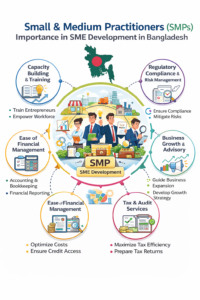
SMPs in Bangladesh play a critical role in supporting SMEs, ensuring compliance, and promoting sound financial governance.

Abstract
SME (Small and Medium Enterprise) is officially standardized by the Ministry of Industries and Bangladesh Bank. Since 2022, the term has been expanded to CMSME (Cottage, Micro, Small, and Medium Enterprises) to be more inclusive of the smallest business units.
As of 2026, the Government of Bangladesh has shifted its focus from mere survival (post-pandemic) to the radical transformation of the CMSME (Cottage, Micro, Small, and Medium Enterprise) sector. The goal is to increase the SME contribution to GDP to approximately 32%.
Small and Medium Practices (SMPs) form the backbone of professional accounting and auditing services for Small and Medium Enterprises (SMEs) in Bangladesh. Unlike large multinational accounting firms, SMPs operate with limited resources but provide highly personalized services. This article examines the role, challenges, and opportunities for SMPs in Bangladesh, with reference to the International Federation of Accountants (IFAC) frameworks, including quality control, audit standards, and ethical requirements.
1. Introduction
Bangladesh’s economy is predominantly driven by SMEs, which account for a significant portion of employment and GDP. SMPs cater specifically to these SMEs, providing essential services such as:
• Audit and assurance;
• Accounting and bookkeeping;
• Tax advisory;
• Business consulting and financial planning.
Despite their crucial role, SMPs face unique challenges including regulatory compliance, technological transformation, and talent retention. Understanding how SMPs operate in Bangladesh through the lens of IFAC frameworks is critical for improving audit quality, governance, and SME growth.
2. Regulatory Environment in Bangladesh
SMPs in Bangladesh are primarily regulated under:
1. The Institute of Chartered Accountants of Bangladesh (ICAB):
i. Oversees licensure and professional conduct of Chartered Accountants;
ii. Enforces local adaptations of IFAC standards;
1. Bangladesh Bank Guidelines (for financial institutions);
2. National Board of Revenue (NBR) for tax compliance and advisory.
2.1 Adoption of International Standards;
a. International Standards on Auditing (ISA): SMPs are expected to conduct audits in compliance with ISA, as recommended by IFAC.
b. IFAC Code of Ethics: Guides SMPs in independence, integrity, and professional behavior.
c. International Financial Reporting Standards (IFRS) for SMEs: Helps standardize accounting practices for SME clients.
3. The Role of SMPs in Bangladesh:
SMPs function as trusted advisors to SMEs, addressing:
3.1 Compliance Services:
• Tax filings, VAT, and statutory audit compliance;
• Ensuring SMEs meet local regulatory and reporting requirements
3.2 Advisory Services:
• Business process improvement;
• Financial planning and budgeting;
• Risk management and sustainability advisory (emerging trend).
3.3 Bridging the Gap:
• Many SMEs lack internal finance expertise; SMPs provide guidance on financial governance;
• Serve as a link between SMEs and banks, investors, and regulatory authorities.
4. Challenges Faced by SMPs in Bangladesh
Challenge Description
Limited resources Small staffing and budget compared to Big 4 firms
Technology adoption Digital accounting, analytics, and cloud platforms are underutilized
Regulatory complexity Keeping pace with frequent updates in tax and corporate law
Talent retention Skilled professionals often migrate to multinational firms
Client awareness SMEs often undervalue SMP advisory services
5. Opportunities for SMPs
1. SME Growth: Bangladesh’s SME sector continues to expand, increasing demand for professional services.
2. Digital Transformation: Adoption of cloud accounting, ERP systems, and analytics can enhance efficiency.
3. IFAC Network Support: Access to international guidelines and training improves service quality.
4. Specialized Advisory Services: Sustainability reporting, internal audit, and risk management provide new revenue streams.
6. IFAC Framework Analysis
The IFAC frameworks provide a benchmark for quality, ethics, and audit standards applicable to SMPs. Key components relevant to Bangladesh:
6.1 Audit Quality Framework
• SMPs can implement quality control policies aligned with IFAC’s International Auditing and Assurance Standards Board (IAASB) guidance.
• Emphasis on risk assessment, documentation, and review procedures ensures consistent audit quality.
6.2 Ethical Requirements
• IFAC Code of Ethics ensures SMPs maintain independence, integrity, and objectivity.
• Crucial for SMEs, where owners and accountants often have close relationships.
6.3 Professional Development
• IFAC emphasizes continuous professional development (CPD).
• SMPs in Bangladesh can leverage ICAB-approved training programs to meet global standards.
6.4 SME-Specific Guidance
• IFAC provides IFRS for SMEs guidance, which SMPs can use to simplify reporting for small businesses while ensuring compliance.
7. Recommendations for Bangladesh SMPs
1. Strengthen Quality Control
• Formal internal review and documentation policies aligned with IFAC AQF
2. Invest in Technology
• Cloud-based accounting, automated tax tools, data analytics
3. Continuous Learning
• Regular CPD and international exposure
4. Client Education
• Demonstrate value-added advisory beyond compliance
5. Collaboration & Networks
• Join regional SMP networks to share best practices and resources
8. Conclusion
SMPs in Bangladesh play a critical role in supporting SMEs, ensuring compliance, and promoting sound financial governance. Alignment with IFAC frameworks enhances audit quality, ethical standards, and international credibility. While challenges such as resource limitations and regulatory complexity exist, SMPs that embrace technology, professional development, and advisory expansion can thrive, contributing significantly to Bangladesh’s economic growth.
References:
1. International Federation of Accountants (IFAC), IFAC Audit Quality Framework, 2023;
2. IFAC, Code of Ethics for Professional Accountants, 2022;
3. Institute of Chartered Accountants of Bangladesh (ICAB), Professional Guidelines & Standards;
4. IFRS Foundation, IFRS for SMEs, 2021.