
ONE VILLAGE ONE PRODUCT (OVOP): HISTORY, EFFECTIVENESS, AND BANGLADESH IMPLEMENTATION MODEL
One Village One Product is not an agriculture project. It is an economic development model. It can reduce poverty, develop SMEs, increase exports, create employment, develop rural economy, reduce migration, increase financial inclusion, increase bank SME portfolio, and develop rural industry etc.

ONE VILLAGE ONE PRODUCT (OVOP): HISTORY, EFFECTIVENESS, AND BANGLADESH IMPLEMENTATION MODEL
1. History of One Village One Product in the World:
The One Village One Product (OVOP) movement started in Japan in the late 1970s. The program originated in Ōita Prefecture, Japan in 1979, initiated by Governor Morihiko Hiramatsu to promote rural development by encouraging each village to produce one high-value product based on local resources.
Basic Philosophy of OVOP:
The OVOP movement was based on three principles:
1. Local but Global: Use local resources but target global markets;
2. Self-Reliance and Creativity: Community-driven development;
3. Human Resource Development: Skill development and entrepreneurship.
The concept later spread worldwide and was adopted in Thailand (OTOP: One Tambon One Product), Philippines, Indonesia, Uganda, Malawi, Latin America countries, Uzbekistan (UNDP programs).
The model focuses on value addition, branding, packaging, marketing, and SME development using local resources.
2. Effectiveness of OVOP in Poverty Reduction and Rural Development:
Economic Impact: Research on OVOP and similar programs shows that they:
• Increase rural income;
• Create employment;
• Promote SMEs;
• Encourage entrepreneurship;
• Reduce rural-urban migration;
• Develop local industries;
• Increase exports of local products;
• Preserve traditional crafts and culture.
For example, Thailand’s OTOP program significantly improved productivity, market access, and income generation for rural enterprises, although implementation challenges existed.
How OVOP Reduces Poverty:
OVOP reduces poverty through:
1. Local production;
2. Value addition;
3. SME development;
4. Job creation;
5. Women entrepreneurship;
6. Rural industrialization;
7. Market linkage;
8. Export development.
Development Flow:
Local Resources->Product->Processing->Packaging->Branding->Marketing->Income->Employment->Poverty Reduction.
This model converts agriculture economy to rural industrial economy.
3. Why OVOP is Important for Rural Development:
OVOP is actually a rural industrialization strategy proved by implementation in some country and UNDP.
The Rural Development Model:
Village->Product->SME->Industry->Market->Income->Development.
Key Benefits From OVOP:
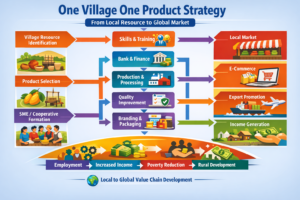
4. Modality: How One Village One Product Works (Implementation Model):
OVOP are being Implemented following the steps below:
Step 1: Identify Village Resources;
Step 2: Select One Product;
Step 3: Form Co-operative/ SME Group;
Step 4: Provide Training;
Step 5: Provide Finance;
Step 6: Improve Quality & Packaging;
Step 7: Branding & Marketing;
Step 8: Market Linkage;
Step 9: Export Promotion.
Step 10: Monitoring & Support.
Institutional Structure Should Be As Under:
1. Government will provide Policy & Infrastructure:
2. Central Bank will provide refinance & SME finance;
3. Commercial Bank will provide project & working capital loans;
4. NGO will give training;
5. Universities will do research on further development of project;
6. Private sector will work for marketing: and
7. Local government will co-ordinate the total project for proper implementation.
This is a multi-stakeholder development model.
5. How It Can Be Worked in Bangladesh:
Bangladesh is very suitable country for OVOP implementation because, it has following suitability:
1. Strong rural economy;
2. Agricultural diversity;
3. Handicrafts;
4. SMEs;
5. Microfinance experience;
6. Mobile banking;
7. Agent banking network.
Possible One Village One Product (OVOP) Examples in Bangladesh are as under (For better understanding):
This could transform rural Bangladesh into a model industrial development example in the world.
6. Role of Commercial Banks in Bangladesh:
Commercial banks can be the main implementing agency. Banks Can Finance:
1. SME loan;
2. Working capital;
3. Equipment loan;
4. Warehouse finance;
5. Supply chain finance;
6. Export finance;
7. Women entrepreneur loan;
8. Cluster finance;
9. Cooperative finance;
10. Digital payment.
Banking Support Model May Be as Under:
Village product group to SME/Co-operative to Commercial Bank loans to Production to Marketing to Income to Loans Repayment.
This is a Cluster Financing Model.
7. Role of Bangladesh Bank and Government:
Bangladesh Bank Can:
• Provide refinance scheme;
• Provide SME credit policy;
• Provide cluster financing policy;
• Provide low interest refinancing;
• Provide credit guarantee scheme;
• Provide export support;
• Encourage agent banking finance;
• Create OVOP financing guideline.
Government Can:
• Identify products;
• Provide training;
• Provide technology;
• Provide packaging support;
• Provide branding;
• Provide export promotion;
• Provide infrastructure;
• Provide market linkage;
• Provide tax incentives.
8. Case Study Example (Hypothetical Bangladesh Case)
Case Study: One Village One Product: Mango Processing in Rajshahi-
Step 1 – Product Selection
Rajshahi Village → Mango
Step 2 – SME Formation
100 farmers → Mango Processing Cooperative
Step 3 – Bank Finance
Commercial bank provides:
• Machinery loan;
• Working capital loan;
• Packaging finance
Step 4 – Production
Products may be:
• Mango juice;
• Mango pulp;
• Mango pickle;
• Dried mango;
• Mango jam.
Step 5 – Branding
Brand: Rajshahi Mango Products
Step 6 – Marketing:
• Supermarket;
• Online;
• Export.
Step 7 – Income Impact:
This is exactly how OVOP will work in rural area of Bangladesh.
9. Complete OVOP Model for Bangladesh:
Integrated Model step by step:
1. Village Resources;
2. Production Selection;
3. SME/Cluster making;
4. Training & Technology;
5. Bank Finance;
6. Production;
7. Processing;
8. Packaging;
9. Branding;
10. Marketing;
11. Export;
12. Income;
13. Poverty Reduction;
14. Rural Development.
10. Strategic Conclusion:
One Village One Product is not an agriculture project. It is an economic development model. It can reduce poverty, develop SMEs, increase exports, create employment, develop rural economy, reduce migration, increase financial inclusion, increase bank SME portfolio, and develop rural industry etc.
If properly implemented, OVOP can become Japan → Rural Development, Thailand → SME Development, Bangladesh → Poverty Reduction + SME + Rural Industrialization.
References:
1. Beck, T., Demirgüç-Kunt, A., & Levine, R. (2005). SMEs, Growth and Poverty.
2. Berger, A. N., & Udell, G. F. (2006). A Conceptual Framework for SME Finance.
3. Hiramatsu, M. (2008). One Village One Product Movement.
4. IFAC (2018). The Role of SMPs in SME Development.
5. OECD (2017). Enhancing SME Contribution to Economy.
6. World Bank (2020). SME Finance and Development Report.
7. Bangladesh Bank SME Credit Policies and Guidelines.
8. Yunus, M. (1999). Banker to the Poor.
9. Porter, M. E. (1985). Competitive Advantage.
10. Kaplan, R. S., & Norton, D. P. (1996). Balanced Scorecard.
11. Kurokawa, K., Tembo, F., & te Velde, D. (2010). Challenges for the OVOP Movement in Sub-Saharan Africa.
12. Hayami, Y. (2009). Village-Based Development and Industrialization Strategy.
13. United Nations Industrial Development Organization reports on rural industrialization. – United Nations Industrial Development Organization.
14. Rural development programs and SME cluster development publications by – United Nations Development Programme.
