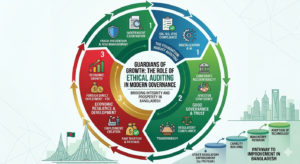
The Trust Architect: How Quality Auditing Foundations Build Bangladesh’s Future
“Beyond the Balance Sheet: Cultivating a Culture of Ethical Vigilance.”

Abstract
In the context of Bangladesh’s rapid transition toward a high-growth, middle-income economy, the integrity of financial reporting has emerged as a critical pillar for sustainable development. This article examines the multifaceted role of auditing not merely as a compliance exercise, but as a strategic instrument for good governance and economic resilience. Despite significant strides, the domestic auditing landscape faces persistent challenges, including the need for enhanced regulatory oversight, the adoption of advanced digital forensics, and the elimination of unethical practices like “opinion shopping.”
By analyzing the correlation between audit quality and Foreign Direct Investment (FDI), this paper argues that a robust, transparent oversight framework, led by the Financial Reporting Council (FRC) and ICAB is essential to lowering the cost of capital and boosting market efficiency.
Ultimately, the article proposes a roadmap for reform centered on technological integration and ethical accountability, asserting that a culture of rigorous auditing is the “trust architect” required to secure Bangladesh’s position in the global financial arena.
Introduction:
At its core, an audit is an independent examination of financial information, records, operations, or performance. Think of it as a “health check-up” for an organization to ensure that what they claim to be doing matches the reality of their books and actions.
Why is Audit So Important?
In any economy, trust is the most valuable currency. Audits are the mechanism that maintains that trust. They examine whether the financial statements give a true and fair view of the books and accounts of the company, whether corporate governance is in practice, the corporation is expected to be a going concern, expenditure incurred is for the corporation’s business, and there are no material mis-statements.
However, an ethical and trust audit confirms:
1. Credibility: It assures shareholders, banks, and investors that financial statements are accurate.
2. Error & Fraud Detection: While not its only purpose, a thorough audit helps uncover discrepancies, waste, or deliberate financial misconduct.
3. Process Improvement: Auditors often identify weaknesses in a company’s internal controls, offering a roadmap to tighten up operations.
4. Compliance: It ensures the entity is following the laws and regulations of the land, preventing legal headaches later.
Improving Audit Quality in Bangladesh:
Bangladesh’s economy is growing rapidly, but the auditing sector faces challenges like “opinion shopping” and a lack of transparency. To ensure transparency, auditors must treat the International Standards on Auditing (ISA), International Accounting Standards (IAS), and International Financial Reporting Standards (IFRS) as an interconnected framework.
Compliance begins with the auditor evaluating whether the financial statements have been prepared, in all material respects, in accordance with the relevant financial reporting framework (IAS/IFRS). Under ISA 200, the auditor is required to maintain professional skepticism and exercise professional judgment throughout the process. This involves a rigorous risk assessment to identify potential material misstatements, followed by the gathering of “sufficient appropriate audit evidence” to support their opinion.
In the context of Bangladesh, this means the auditor must verify that the company’s accounting policies (governed by IAS/IFRS) are consistently applied and that the resulting disclosures are transparent and neutral. By strictly adhering to the procedural roadmaps laid out in the ISA, auditors provide the “reasonable assurance” necessary to certify that the financial health of the entity is presented fairly to all stakeholders.
To elevate the standard, several steps are crucial:
1. Strict Enforcement by Regulators: Bodies like the Financial Reporting Council (FRC) and ICAB must strictly monitor audit firms. Penalties for negligence or collusion should be severe enough to act as a real deterrent.
2. Digitalization: Moving away from manual, paper-based auditing toward Data Analytics and AI can help identify patterns of fraud that the human eye might miss.
3. Independence & Rotation: Implementing mandatory audit firm rotation ensures that auditors don’t become “too cozy” with the management of the companies they are supposed to be checking.
4. Capacity Building: Investing in continuous professional development to ensure local auditors are well-versed in the latest International Financial Reporting Standards (IFRS).
Establishing Good Governance and Economic Development:
Ethical and high-quality audits act as a bridge between a developing nation and a thriving economy. It can bring the ultimate goals by:
1. Building Investor Confidence:
When international investors see that Bangladeshi companies undergo rigorous, ethical audits, they feel safer bringing in Foreign Direct Investment (FDI). This capital is essential for infrastructure and job creation.
2. Strengthening Good Governance:
Good governance is about accountability. An ethical audit forces transparency. When boards of directors know an independent auditor will scrutinize their decisions, they are more likely to act in the best interest of the stakeholders rather than for personal gain. The independent director in board should be chosen by the regulator not by the sponsors. They also should go under a ‘fit and proper’ test and their remuneration should be determined by regulators.
3. Fair Taxation and Revenue:
Accurate audits ensure companies report their true profits. This leads to fair tax collection, providing the government with the necessary revenue to fund public services like education and healthcare.
4. Reducing the “Cost of Capital”:
When a country has a reputation for high-quality auditing, banks and lenders view businesses as less risky. This allows companies to borrow money at lower interest rates, fueling faster industrial growth.
Conclusion
In summary, auditing is the fundamental engine of transparency and accountability that drives a modern economy. For Bangladesh, transitioning from a developing to a high-income nation requires more than just industrial growth; it demands a financial ecosystem built on the rigorous application of ISA, IAS, and IFRS. By addressing current systemic gaps through digitalization, stricter regulatory oversight by the FRC, and an unwavering commitment to professional ethics, the auditing profession can transform from a mere compliance requirement into a powerful catalyst for Good Governance.
Ultimately, an environment where financial data is trusted is an environment where investment flourishes, ensuring a stable and prosperous economic future for the nation.