
THE QUIET INK OF TWO HEARTS

Chapter One
A House Without Voices
In the far northern edge of Japan, beyond fast trains and bright cities, stood a small town called Kamikawa. It was a place where time moved slowly, and silence spoke louder than people.
In this town lived Aiko Mori.
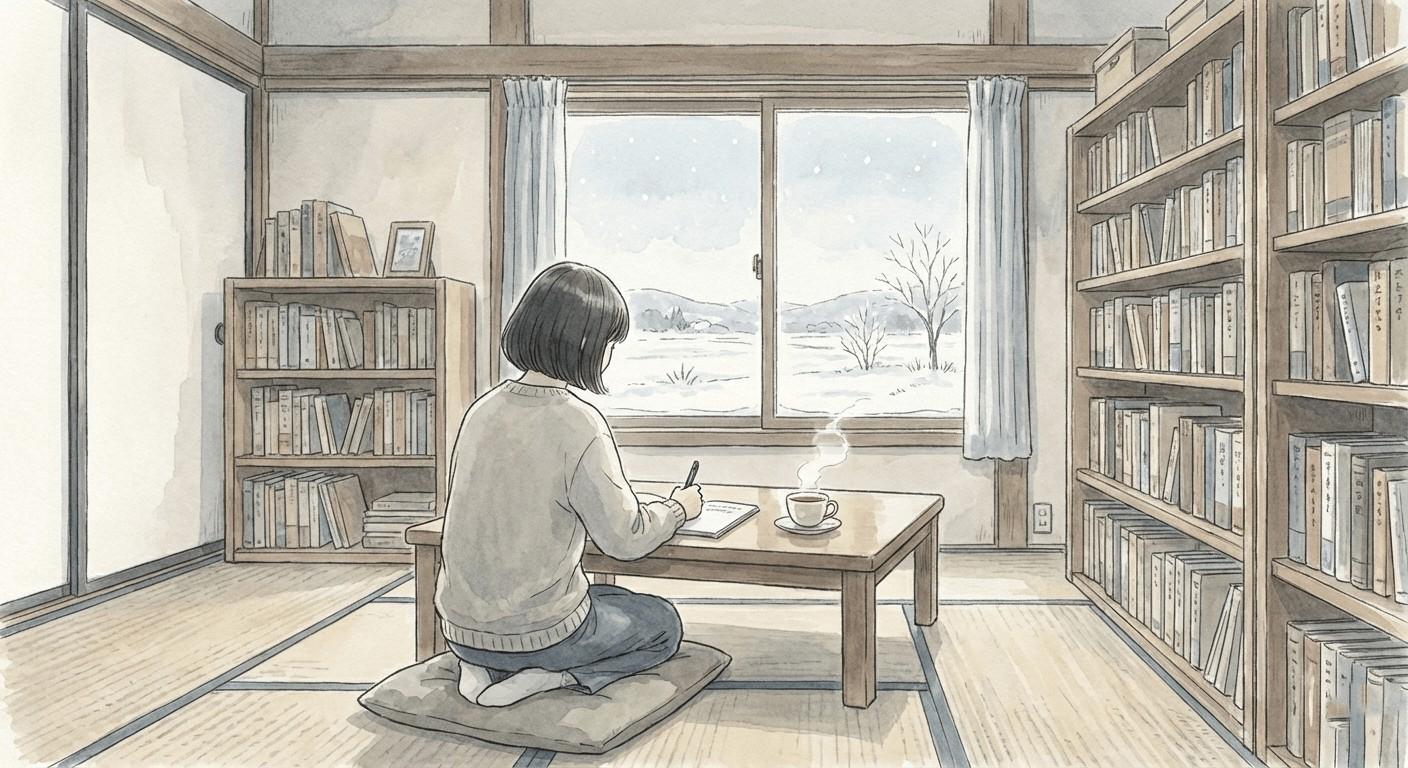
Her house was small, wooden, and old. It had no photographs on the walls. No family stories lived there. Only books, many books, lined the shelves, resting like quiet companions.
Aiko had lost her parents when she was very young. No one spoke much about them. Life simply moved on, leaving her behind to grow up early. She learned to cook alone, to study alone, and to cry without witnesses.
By the time she reached adulthood, she had learned a hard lesson:
People may leave, but words remain.
So she chose words.
She studied literature, then journalism, and slowly became one of the most respected writers in a national newspaper. Her columns spoke about broken families, neglected children, and emotional emptiness in modern society. She did not accuse. She observed. And that made her writing powerful.
Now in her mid-forties, Aiko lived alone, unmarried.
People often asked why.
She never answered.
Chapter Two
The Discipline of Solitude
Aiko’s days followed a strict rhythm.
She woke up early, made simple food, and wrote before the world became noisy. Writing was not just her job, it was her discipline, her protection. She believed emotions could weaken clarity, and attachments could slow purpose.
Marriage had come as a question many times. She ignored it each time.
Not because she disliked love, but because she feared loss.
Family mattered deeply to her. That was why she wrote against family breakdown so fiercely. She knew what absence did to a human heart.
Her editors respected her. Readers trusted her. But few knew her personally.
She kept her life narrow, controlled, and quiet.
Until a new voice entered the newsroom.
Part Two
Cracks Beneath the Calm
Ryo began to notice how carefully Aiko lived.
She avoided gatherings. She left office meetings early. She never spoke about her past unless it was about society. Never about herself.
One evening, while reviewing an article about rising divorce rates, Ryo asked gently,
“Do you believe families can still be saved?”
Aiko paused.
“Yes,” she said slowly. “But only if we stop treating relationships as convenience.”
Her voice carried pain.
Ryo realized something then — Aiko was not writing about society alone. She was writing about herself.
His love deepened, mixed now with sorrow.
Epilogue
Some loves are not meant to stay as people.
Some loves are meant to stay as purpose.
Different paths.
Same ink.
And somewhere between words and silence,
hope remained.