

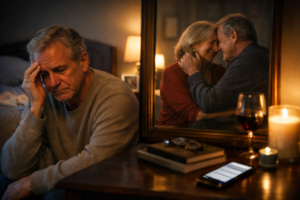
 Late-life romance, emotional or romantic relationships emerging in the later stages of adulthood—has become an important subject in Psychology, Gerontology, and Sociology. Contrary to the stereotype that love belongs mainly to youth, research shows that emotional attachment, companionship, and romantic longing often remain strong even in the 50s, 60s, or beyond.
Late-life romance may occur within marriage (renewed affection) or outside marriage (extramarital emotional attachment). Psychologically, it arises from several deep human needs and life-stage dynamics.
1. Emotional Reawakening in Later Life
In earlier adulthood, individuals focus heavily on career building, raising children, and financial responsibilities. As these pressures decrease, a psychological space opens for reflection and emotional awareness.
This period can trigger what some psychologists describe as a “second emotional awakening.”
Individuals may start asking: Was my life emotionally fulfilling? Did I sacrifice too much of my personal self for duty? Is there still time to experience deeper emotional connection?
Such introspection sometimes leads to new romantic feelings, especially when someone appears who listens, appreciates, or intellectually connects with them.
2. Erikson’s Developmental Perspective
The developmental psychologist Erik Erikson proposed stages of psychosocial development. In later adulthood, individuals face the stage called Integrity vs. Despair. Integrity occurs when people feel their life has meaning and fulfillment. Despair arises when they feel regret, loneliness, or emotional incompleteness. Late-life romance may serve as a psychological attempt to achieve emotional integrity, filling gaps left by years of responsibility or neglected personal desires.
3. The Need for Emotional Validation
With aging, many people experience a reduction in external validation. Examples include:
• Retirement reducing professional recognition;
• Children becoming independent;
• Social circles shrinking.
Romantic attention from another person can restore feelings of:
• personal worth
• attractiveness
• emotional significance
Psychologically, this validation can be very powerful.
4. Companionship vs. Passion
Late-life romance often differs from youthful romance. Instead of intense physical passion, it tends to emphasize, deep conversation, intellectual companionship, empathy and understanding, and emotional safety.
This aligns with the Socioemotional Selectivity Theory, proposed by Laura L. Carstensen, which suggests that as people age, they prioritize emotionally meaningful relationships over broad social networks.
5. The Psychology of Extramarital Late-Life Love
When late-life romance occurs outside marriage, it often reflects underlying psychological gaps such as:
a. Emotional neglect in long marriages
Many couples become functionally cooperative but emotionally distant.
b. Identity rediscovery
People may seek a relationship where they feel “seen” as an individual, not just a spouse or parent.
c. Intellectual compatibility
Shared ideas, discussions, and emotional understanding can trigger deep attachment.
In such cases, the relationship may be more psychological and emotional than physical.
6. Cognitive and Hormonal Factors
Even biologically, aging does not eliminate romantic capacity. Research in Neuroscience shows that emotional bonding involves neurotransmitters such as dopamine (reward and pleasure), oxytocin(bonding and trust), and serotonin (emotional stability).
These systems remain active in later life, meaning the brain continues to respond to affection and attachment.
7. Moral Conflict and Psychological Stress
Late-life romance, especially when secret, can create strong cognitive dissonance, a concept introduced by Leon Festinger.
The individual experiences tension between personal emotions, moral beliefs, and family responsibilities. This conflict may lead to guilt, anxiety, emotional exhaustion, and divided loyalty.
Therefore, a “double life” often produces psychological strain even if the relationship itself feels meaningful.
8. Positive Psychological Outcomes
Despite the complexities, late-life romance can have positive effects such as-
• reduced loneliness;
• improved mental health;
• renewed enthusiasm for life;
• better cognitive engagement;
• increased sense of purpose.
In many cases, companionship itself becomes a powerful form of psychological support.
9. Cultural Context
In collectivist societies like Bangladesh, romantic relationships are strongly tied to family structure and social reputation. Therefore, late-life romance, particularly extramarital faces strong moral and cultural resistance.
This cultural pressure often forces such relationships into secrecy, increasing psychological tension.
10. Wisdom and Emotional Responsibility
The central psychological challenge of late-life romance is balancing emotional truth with ethical responsibility. Healthy responses may includes honest self-reflection, respectful communication with family, maintaining dignity for all people involved, avoiding decisions driven purely by temporary emotion.
In later life, love becomes less about excitement and more about meaning, companionship, and emotional maturity.
Final word, late-life romance is not merely a romantic event, it is a psychological phenomenon shaped by aging, identity, loneliness, and the human desire to be emotionally understood.
