
Why Bank Officials Should Have Business Knowledge and How Effective Loan Monitoring Can Prevent NPL- A Bangladesh Perspective.
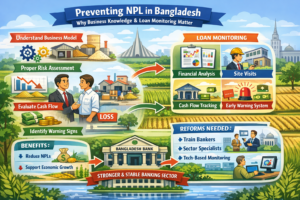
NPLs can be prevented by expert appraisal of loans and monitoring after disbursement.

 1. Introduction:
In modern banking, lending is not merely a financial transaction, it is an investment decision based on the viability of a business. In countries like Bangladesh, where the banking sector plays a dominant role in financing economic activities, the quality of loan appraisal and monitoring directly affects the level of Non-Performing Loans (NPLs).
Over the past decade, rising NPLs have become a major concern for the banking sector under the supervision of Bangladesh Bank. One main reason, Bangladesh earlier monitor commercial banks performances after being NPLs/risks taken. They imposed additional provision but could not prevent NPLs.
Again, other important reason is that many lending decisions are made based on collateral or relationship rather than deep understanding of the borrower’s business model.
Therefore, bank officials must possess strong business knowledge, and continuous loan monitoring must be institutionalized to prevent loan deterioration. External Auditors also feels pressure from various corner to give fair opinion.
1. Why Bank Officials Should Have Business Knowledge:
Banks are dealing as custodian of public money which must be returned on demand or in time, banks will suffer. When they are appraising a loan proposal without understanding of business knowledge, they may take high risk which will ultimately fall on depositors. So, business knowledge for bankers are must for following reason:
1.1 Understanding the Borrower’s Business Model:
A bank officer must understand that how the business generates revenue, cost structure and profit margins, market demand and competition, supply chain dependencies etc.
For example, if a borrower runs a rice mill, the officer should understand paddy procurement cycle, seasonal price fluctuations, storage costs and risks, revenue movements etc.
Without such knowledge, loan appraisal becomes mechanical and risky.
1.2 Proper Credit Risk Assessment:
Business knowledge helps bankers evaluate industry risk, operational risk, market volatility, cash flow sustainability.
For example, textile exports depend on global demand, estate depends on urban purchasing power etc. Without understanding industry dynamics, loans may be approved for non-viable projects, leading to default.
1.3 Evaluating Cash Flow Instead of Collateral:
In traditional banking in Bangladesh, loans are often approved based on collateral value. However, international best practice emphasizes cash flow lending.
Business knowledge helps officers assess whether the business can generate enough cash to repay loans. This aligns with the credit risk principles of theBasel Committee on Banking Supervision.
1.4 Identifying Early Warning Signals:
A banker who understands business operations can detect warning signs such as declining sales, rising or declining inventory, fund diversion, delayed supplier payments, and/or loss of major customers
These signals often appear months before loan default.
1.5 Supporting Economic Development:
Bankers with business knowledge become financial advisors to entrepreneurs. They can guide borrowers on working capital management, investment planning, cost control etc. This strengthens productive sectors and contributes to GDP growth.
2. Loan Monitoring: A Critical Tool to Prevent NPL:
Loan monitoring means continuous supervision of borrowers after loan disbursement. Many NPLs occur not because of bad projects but because banks stop monitoring after disbursement.
3. Key Loan Monitoring Mechanisms:
3.1 Regular Financial Statement Analysis:
Bankers should aware and monitor that borrowers submitting monthly sales reports, quarterly financial statements, and annual audited accounts.
Bankers should know the analysis of audited financial statements and interpret it as bankers always should be a financial analyst/financial planner. Bank officers should analyze profitability trends, debt servicing capacity, liquidity ratios etc.
3.2 Site Visits and Business Inspection:
Physical visits allow bankers to verify production level, inventory status, machinery usage, and workforces activity.
In Bangladesh, some loans become NPL because projects never actually operate after disbursement.
3.3 Monitoring Cash Flow through Banking Channel:
Banks should ensure business transactions flow through bank accounts, sales proceeds are deposited in the lending bank. This helps track real business activity.
3.4 Early Warning System (EWS):
Banks should identify red flags such as cheque returns, declining turnover, excess overdraft utilization, delayed installment payment etc.
Early action can prevent loans from becoming NPL.
3.5 Sector-Specific Monitoring:
Bankers should know that different sectors require different monitoring approaches. For example agricultural sector demands seasonal production cycle, garments sector is on export orders and its management, real estate demands apartment sales and in SME, bankers should look into cash flow and inventory.
4. Causes of NPL in Bangladesh:
In Bangladesh, several structural issues contribute to NPL growth such as weak credit appraisal, political influence in lending, poor post-disbursement monitoring, diversion of loan funds, weak legal enforcement etc.
Strengthening business-oriented banking culture can significantly reduce these problems.
5. Recommended Reforms for Bangladesh Banking Sector:
5.1 Business Training for Bankers
Every bank should have strong training institute with industry expert facultries. Generally, in Bangladesh, every bank have a training institute in name but not effective. Banks should have long term strategic planning for man power development.
Banks should train officers in industry analysis, financial modelling, business strategy etc. Bangladesh Bank should monitor it which is now rarely done.
5.2 Sector Specialists:
Every Banks should appoint sector specialists for sectoral suggestion by research such as textile experts, agriculture finance specialists, SME analysts etc.
5.3 Technology-Based Monitoring:
Now a days, world wide banks are using technology with AI in monitoring loan performance. In Bangladesh, we also should use real-time transaction monitoring, AI-based risk detection, digital financial reporting etc.
5.4 Strengthening Internal Credit Audit:
In Bangladesh, internal credit audit is absent although internal audit are there with low performer officials. Internal audit in banking industry in the neglected division although the audit is under Board Audit Committee.
Additionally, regular credit audit can detect, policy violations, weak monitoring potential defaults.
6. Conclusion:
The prevention of NPL is not only a matter of strict regulation but also professional banking competence.
Bank officials must evolve from loan processors to business analysts. When bankers understand the borrower’s business and continuously monitor loan performance, they can detect risks early and take corrective actions.
For the banking sector of Bangladesh, strengthening business knowledge and loan monitoring culture is essential to ensure financial stability and sustainable economic development under the oversight of Bangladesh Bank.
