
Bangladesh’s Growth Story: Progress, Inequality and the Governance Challenge
While the economy has expanded significantly, uneven income distribution, weaknesses in financial governance, and institutional gaps continue to shape the national policy debate.

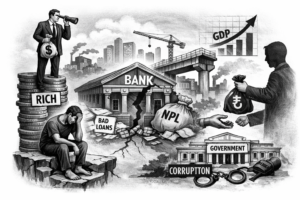 In public discussions about Bangladesh’s economic trajectory over the past 17 years, a recurring claim often emerges: the poor are becoming poorer, the rich richer, and governance is weakening. Alongside this concern, critics argue that large volumes of bank credit have been taken with limited productive use, institutional governance has weakened, and public infrastructure projects have sometimes experienced significant cost escalation.
These observations raise important political-economic questions. However, a meaningful assessment requires separating perception from structural realities and examining available evidence with balance and nuance.
Income Inequality: Did the Rich Get Richer?
Available evidence suggests that income and wealth inequality have increased over time. While Bangladesh achieved impressive reductions in poverty during the past two decades, income distribution has become more uneven.
Studies by the World Bank indicate that although national income expanded significantly, the Gini coefficient—which measures income inequality—has gradually risen. This implies that economic growth did occur, but its benefits were not distributed evenly across society.
Such a pattern is not uncommon in rapidly growing developing economies. Growth often benefits capital owners, entrepreneurs, and skilled workers faster than informal or low-skilled labor. Without deliberate policy interventions—such as targeted social protection, quality education, and inclusive financial systems—inequality may widen even during periods of strong economic growth.
Poverty Dynamics: Progress with Vulnerabilities
Despite concerns about inequality, Bangladesh has historically achieved notable reductions in extreme poverty. But if it is considered that the wealth of the rich is growing, it is found that the poor become poorer. However, the pace of poverty reduction has slowed in recent years due to global and domestic shocks, including the COVID-19 pandemic, global inflationary pressures, and rising energy prices.
Research cited by the Asian Development Bank suggests that many households remain economically vulnerable. These families may move above the poverty line during stable periods but can fall back into poverty when faced with economic shocks.
The reality, therefore, is more nuanced:
Absolute poverty has declined, but relative inequality has increased.
Banking Sector and Allocation of Credit
Another widely discussed issue concerns the effectiveness of bank lending in supporting productive investment. In recent years, the banking sector has extended large volumes of credit, yet questions remain about whether these funds have consistently translated into productivity gains.
Analyses by the International Monetary Fund highlight several structural challenges within the financial system, including relatively high levels of non-performing loans, governance weaknesses in some financial institutions, and concentration of credit among large borrowers.
When credit is misallocated or diverted away from productive uses, economic efficiency declines, and financial stability may be undermined.
Governance and Institutional Effectiveness
Institutional governance plays a central role in long-term economic development. When public institutions do not operate strictly according to their defined mandates or Terms of Reference (TOR), several risks arise, including gaps in policy implementation, administrative inefficiencies, and potential regulatory capture.
Institutional economists consistently emphasize that strong institutions—characterized by transparency, accountability, and rule-based governance—are among the most important foundations of sustainable development.
Infrastructure Spending and Economic Growth
Over the past decade and a half, Bangladesh has undertaken large infrastructure investments aimed at improving connectivity, energy supply, and overall economic capacity. The investments are made without a proper appraisal of economic benefits, and without evaluating repayment capacity.
Such investments can contribute positively to economic growth by stimulating construction activity, generating employment, and improving logistical efficiency, if they are properly implemented. However, economists often caution that the quality of infrastructure governance is as important as the size of spending.
When projects face delays, cost escalation, or inefficiencies, their economic benefits may be reduced. Effective project management, transparent procurement systems, and strong oversight mechanisms are therefore essential.
Corruption and Political Economy
Concerns about corruption and rent-seeking behavior are common in many developing economies. Research and perception indices published by Transparency International suggest that corruption can have several adverse economic effects such as distortion of resource allocation, increased public project costs, and erosion of public trust in institutions.
Strengthening accountability mechanisms and institutional transparency is therefore critical for ensuring that development spending fully benefits society.
Political Accountability and Public Trust
Public perceptions that patriotism or public service motivation among political actors may be declining reflect a broader issue: trust in governance.
Political scientists widely agree that sustainable economic development depends not only on economic policy but also on the strength of democratic institutions, including:
– transparency in decision-making
– accountability of public officials
– effective checks and balances within governance systems.
These elements help ensure that growth translates into shared prosperity and social stability.
In final words, Bangladesh’s economic experience over the past two decades presents a complex and mixed picture.
On one hand, the country has shown achievement of significant progress, including sustained GDP growth, substantial reductions in extreme poverty, and major infrastructure improvements, but overall position shows a hodgepodge situation in the economic, political, and social environment before taking power of the new government in 2026.
Structural challenges remain present in all areas of administration and development. Rising inequality, weaknesses in parts of the banking sector, siphoning of money and assets from the country, concerns, and uneven distribution of economic gains continue to shape policy debates.
The central policy challenge today is therefore not simply whether economic growth has occurred. Rather, it is how to ensure that growth becomes more inclusive, more transparent, and institutionally sustainable, so that the benefits of development are broadly shared across society. The patriotism in the mind of the total population should be deep-rooted, how it could be done, the government should think of it.
