Management Time: Who’s Got the Monkey?
A thought to be remember tha, “Do not become the permanent caretaker of problems that your people are capable of solving. Give them the responsibility, the authority, the guidance, and the trust to carry their own monkeys.”

Management Time: Who’s Got the Monkey?
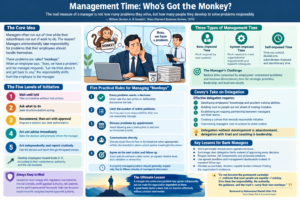
Harvard Business Review published an artice written by William Oncken Jr. and Donald L. Wass originally published in 1974. The central idea
of the was article, why managers often run out of time while their subordinates run out of work to do. The reason is that managers unintentionally take responsibility for problems that their employees should handle themselves.
The authors call these problems “monkeys.” Each monkey represents a task, decision, or problem requiring the next action. When an employee says, “Boss, we have a problem,” and the manager responds, “Let me think about it and get back to you,” responsibility often shifts from the employee to the manager, although manager’s job is not to solve every problem, but to develop people who can solve problems themselves.
There are three types of management time, such as, boss-imposed time-work required by the manager’s superior, system imposed time-work needed to meet organizational requirements and support collegues, and self-imposed time-time the manager controls dividend into subordinates-imposed and discretionary time .
The manager’s challenge is to reduce time consumed by employees’ unresolved problems and increase discretionary time for strategic priorities, leadership, and business results.
The writers identifies five levels of initiative, from lowest to highest.
1. Wait until told: The employee takes no initiative without instructions.
2. Ask what to do: The employee seeks directions before acting.
3. Recommend, then act with approval: The employee proposes a solution and seeks authorization.
4. Act and advise immediately: The employee makes the decision and promptly informs the manager.
5. Act independently and report routinely: The employee owns the decision and reports through the agreed process.
The authors encourage managers to develop employees toward levels 3–5, according to their competence, authority, and the risk involved.
Here the writers suggest five practical rules for managing “monkeys”:
– Every problem needs a decision. Either take the next action or deliberately discontinue the task.
– Limit the number of active problems. Managers should not accept more responsibilities than they can reasonably manage.
– Discuss problems by appointment. Avoid allowing every interruption to become an immediate priority.
– Communicate directly. Discuss issues face-to-face or by telephone when appropriate; written documentation alone cannot replace meaningful discussion.
– Agree on the next action and follow-up. Every task should have a clear owner, an agreed initiative level, and a deadline or review time.
The article suggests that a properly managed problem should generally require only five to fifteen minutes of managerial discussion.
Stephen R. Covey’s leadership expert & writer of “The Seven Habits of Highly Effective People” has added that delegation is not simply a matter of handing problems back to employees.
Effective delegation requires:
– Developing employees’ knowledge and problem-solving abilities.
– Building trust so people are not afraid of making mistakes.
– Establishing an ongoing partnership between managers and their teams.
– Creating an organizational culture that rewards responsible initiative.
– Overcoming managers’ own reluctance to share control.
In other words, delegation without development is abandonment, delegation with trust and coaching is leadership. This last sentence is a synthesis of the article’s message, not a direct quotation.
The lesson is especially relevant that are as,
– personally resolving every operational issue be encourage to empowering responsible department heads.
– approving every routine decision be encouraging establishing clear delegation limits.
– receiving problems without recommendations be requiring options, risk, assessments, and proposed solutions.
– following up repeatedly be using agreed deadlines and management dashboards, and
– becoming the organization’s bottlenect to be developing accountable, decision-capable leaders.
Delegation must remain consistent with regulatory requirements, internal controls, credit approval authority, risk appetite, and the bank’s governance framework. High-risk decisions should never be delegated beyond approved authority.
The ultimate lesson is that a manager who solves every problem may appear indispensable, but can inadvertently make the organization dependent on them. A great leader builds a team that can function effectively without constant intervention. The real measure of managerial effectiveness is not how many problems the leader personally solves, but how many people they develop to solve problems responsibly.
A thought to be remember tha,
“Do not become the permanent caretaker of problems that your people are capable of solving. Give them the responsibility, the authority, the guidance, and the trust to carry their own monkeys.”
Reviewed by Mohammed Shahid Ullah FCA
Senior Banker, Risk & Governance Expert.