
Islamic Banking: Historical Evolution, Religious Foundations, Financial Viability, and Future Prospects in Bangladesh
Prohibition of Riba (Interest): The Quran declares that those who consume riba will not stand (on the Day of Judgment) except as one driven to madness by Satan's touch. It explicitly states: "Allah has permitted trade and forbidden interest" (Surah Al-Baqarah 2:275).

Abstract:
Islamic banking has emerged as a significant alternative to conventional financial systems, grounded in ethical, asset-based, and risk-sharing principles derived from Islamic law. This article examines the historical evolution of Islamic banking globally and in Bangladesh, analyzes its religious appropriateness, evaluates its financial viability, and explores its future prospects in the Bangladeshi context. The study finds that Islamic banking is not only a faith-based system but also a resilient and inclusive financial model with strong growth potential in Bangladesh.
1. Introduction:
The global financial system has undergone profound transformations over the past century. Amid recurring financial crises and increasing concerns over inequality and ethical lapses, Islamic banking has gained prominence as an alternative paradigm. Rooted in the principles of the Qur’an and the teachings of Prophet Muhammad, Islamic banking prohibits interest (Riba) and promotes justice, equity, and real economic activity.
Bangladesh, as a Muslim-majority country, presents a fertile ground for the development of Islamic banking. Since its inception in the early 1980s, the sector has grown steadily, contributing significantly to financial inclusion and economic development.
2. Historical Evolution of Islamic Banking:
2.1 Global Development:
The conceptual foundation of Islamic finance dates back to the early Islamic era, where trade and commerce were conducted on profit-sharing and ethical principles. In 7th century, Trade practices in early Islamic societies followed profit-sharing instead of interest. Then in Medieval period, Islamic financial principles influenced trade across the Middle East, North Africa, and parts of Europe.
The Modern Revival (20th Century) started in 1963 with the establishment of ‘First modern Islamic bank experiment in Egypt (Mit Ghamr).’ In 1975, Islamic Development Bank (IDB) established and then Dubai Islamic Bank founded as first full-fledged Islamic commercial bank. The establishment of Islamic Development Bank marked a turning point in institutionalizing Islamic finance globally.
However, the modern institutional form began in the 20th century.
Subsequently, international standard-setting bodies such as AAOIFI and IFSB played critical roles in harmonizing practices and ensuring regulatory compliance. However, the modern institutional form began in the 20th century.
Today, Islamic banking operates in more than 80 countries with exceeding $3 trillion assets. exceeding trillions of dollars.
2.2 Development in Bangladesh
Islamic banking in Bangladesh began with the establishment of Islami Bank Bangladesh Limited in 1983. This pioneering initiative introduced Shariah-compliant banking practices in the country.
Over the decades, 11 Islamic banks have been established, namely Islami Bank Bangladesh PLC, Al-Arafah Islami Bank PLC, Social Islami Bank PLC, Shahjalal Islami Bank PLC, First Security Islami Bank Limited, Exim Bank PLC, Union Bank PLC., Global Islami Bank PLC., Standard Islami Bank PLC. ICB Islami Bank PLC., and Sommilito Islami Bank PLC.
Additionally, about 30 conventional banks have introduced Islamic banking windows with more than 900 branches operating in Bangladesh to cater growing demand.
Islamic banking now accounts for 25% banking shares of deposits and 30% investments (Loans) in Bangladesh, demonstrating its increasing acceptance and institutional strength.
3. Religious Foundations of Islamic Banking:
Islamic banking finds its primary justification in the Quran through the strict prohibition of riba (interest/usury) and the emphatic endorsement of bai (trade/commerce). The Quran establishes an ethical framework for financial transactions that emphasizes justice, risk-sharing, and the avoidance of exploitation, directing that money should function as a medium of exchange rather than a commodity that generates profit on its own.
Key Quranic Justifications and Principles:
3.1 Prohibition of Riba (Interest):
The Quran declares that those who consume riba will not stand (on the Day of Judgment) except as one driven to madness by Satan’s touch. It explicitly states: “Allah has permitted trade and forbidden interest” (Surah Al-Baqarah 2:275).
3.2 Trafficking (Trade) is not like Usury”:
The Quran explicitly rejects the argument that charging extra for time is the same as profit from trade. It emphasizes that in trading, risk and profit are shared, whereas in interest, the lender secures a gain while the borrower bears all risks, which is deemed exploitative.
3.3 Establishment of Justice:
The Quran commands fair dealing: “And do not consume one another’s wealth unjustly or send it in bribery to the rulers…” (Surah Al-Baqarah 2:188). Islamic banking aims to remove harm and injustice from financial transactions.
3.4 Profit and Loss Sharing (PLS):
Instead of interest, Islamic banks are encouraged to operate on partnership principles, such as Mudarabah (profit-sharing) and Musharakah (equity participation), which are seen as consistent with the spirit of Quranic trade.
3.5 Materiality (Underlying Asset):
All transactions must be directly linked to a real underlying economic transaction (a tangible asset or service), avoiding speculation (maisir) and excessive uncertainty (gharar).
3.6 Giving up Riba:
Believers are urged to give up any outstanding riba as a test of faith, and if they do not, they are warned of a “war from Allah and His Messenger” (Surah Al-Baqarah 2:278-279).
Other Justifications:
3.7 Principles of Risk Sharing and Asset-Backed Financing:
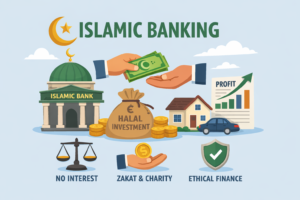
Islamic banking promotes profit-and-loss sharing mechanisms such as Mudarabah and Musharakah, fostering partnership-based finance. Additionally, financing must be linked to tangible assets, ensuring that money is not treated as a commodity.
3.8 Ethical Investment:
Investments are restricted to halal (permissible) sectors, avoiding industries such as alcohol, gambling, and other unethical activities.
4. Financial Viability of Islamic Banking:
4.1 Stability and Resilience:
Islamic banks demonstrated relative resilience during the Global Financial Crisis 2008, primarily due to their asset-backed nature and limited exposure to speculative instruments.
4.2 Risk-Sharing Mechanism
Unlike conventional banking, Islamic banking distributes risk between financial institutions and clients. This reduces the likelihood of systemic defaults and promotes responsible financing.
4.3 Financial Inclusion
Islamic banking attracts individuals who avoid conventional banking due to religious concerns, thereby enhancing financial inclusion in Muslim-majority societies like Bangladesh.
4.4 Ethical and Sustainable Finance
The emphasis on ethical investments aligns Islamic banking with global trends in sustainable and socially responsible finance.
5. Future Prospects of Islamic Banking in Bangladesh:
5.1 Growth Potential:
With a predominantly Muslim population, Bangladesh offers significant growth opportunities. Islamic banking is expected to expand its market share further in the coming years.
5.2 Digital Transformation:
The integration of Islamic banking with fintech and mobile financial services, such as bKash, can revolutionize service delivery and outreach.
5.3 Development of Sukuk Market:
The introduction of Sukuk (Islamic bonds) can provide alternative financing for infrastructure and development projects, reducing reliance on conventional debt instruments.
5.4 Regulatory Strengthening:
The role of Bangladesh Bank is crucial in developing a robust regulatory framework, ensuring Shariah compliance, and maintaining financial stability.
5.5 Challenges:
Despite its growth, Islamic banking in Bangladesh faces several challenges:
• Lack of standardized Shariah governance
• Limited product innovation
• Human resource constraints
• Public perception issues
6. Conclusion:
Islamic banking represents a unique convergence of faith and finance. Its prohibition of interest, emphasis on ethical investment, and focus on risk-sharing make it both religiously appropriate and economically viable. In Bangladesh, the sector has demonstrated remarkable growth and resilience, positioning itself as a key component of the financial system.
Looking ahead, with appropriate regulatory support, technological integration, and product innovation, Islamic banking in Bangladesh is poised to play a transformative role in achieving inclusive and sustainable economic development.
Keywords:
Islamic Banking, Bangladesh, Riba, Shariah Compliance, Financial Inclusion, Sukuk, Ethical Finance.
