
The Village Ambiance: Peace Rests There
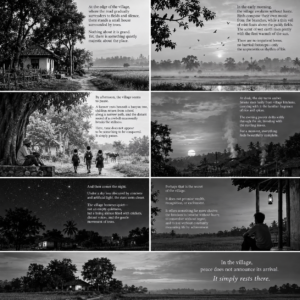
At the edge of the village, where the road gradually surrenders to fields and silence, there stands a small house surrounded by trees. Nothing about it is grand. Yet, there is something quietly majestic about the place.
In the early morning, the village awakens without haste. Birds compose their own music from the branches, while a thin veil of mist floats above the paddy fields. The scent of wet earth rises gently with the first warmth of the sun. There are no impatient horns, no hurried footsteps—only the unpretentious rhythm of life.
By afternoon, the village seems to pause. A farmer rests beneath a banyan tree, children return from school along a narrow path, and the distant sound of a cowbell occasionally breaks the stillness. Here, time does not appear to be something to be conquered. It simply passes.
At dusk, the sky turns amber. Smoke rises lazily from village kitchens, carrying with it the familiar fragrance of rice and spices. The evening prayer drifts softly through the air, blending with the rustling leaves. For a moment, everything feels beautifully complete.
And then comes the night.
Under a sky less obscured by concrete and artificial light, the stars seem closer. The village becomes quiet—not an empty quietness, but a living silence filled with crickets, distant voices, and the gentle movement of trees.
Perhaps that is the secret of the village.
It does not promise wealth, recognition, or excitement. It offers something far more elusive: the freedom to breathe without hurry, to remember without regret, and to live without constantly measuring life by achievement.
In the village, peace does not announce its arrival.
It simply rests there.