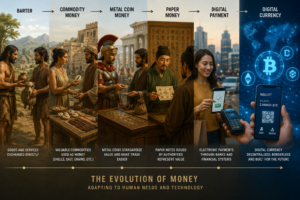
Evolution of Money: From Barter to Digital Currency
How Humanity’s Greatest Financial Innovation Continues to Transform Civilization

Introduction:
Money is one of humanity’s most influential inventions. It has transformed civilizations, enabled global commerce, accelerated technological innovation, and shaped political and economic systems for thousands of years. Yet money itself has never remained static. Throughout history, it has continuously evolved to solve the limitations of previous exchange systems while adapting to changing economic realities.
The journey from simple barter exchanges to sophisticated digital currencies represents more than a technological transformation; it reflects the evolution of trust, institutions, markets, and human cooperation. Today, as central banks explore digital currencies and private innovations redefine payments, understanding the historical evolution of money has become essential for policymakers, financial professionals, businesses, and individuals alike.
This article explores the chronological development of money, highlighting the economic forces that drove each stage of its evolution and examining what the future may hold.
1. The Barter Economy: The Beginning of Exchange:
Long before coins or banknotes existed, societies relied on barter—the direct exchange of goods and services.
A farmer exchanged grain for livestock. A potter traded pottery for clothing. While functional in small communities, barter suffered from a fundamental limitation known as the double coincidence of wants. Both parties had to desire exactly what the other possessed at the same time.
Additional challenges included:
* Lack of standardized value
* Difficulty storing wealth
* Indivisibility of many goods
* High transaction costs
* Limited scalability
As societies expanded, barter became increasingly inefficient, creating the need for a universally accepted medium of exchange.
2. Commodity Money: Value Within the Object:
The next evolutionary step was commodity money—items possessing intrinsic value that became widely accepted in trade.
Different civilizations adopted different commodities:
* Salt in ancient Rome
* Cowrie shells across Asia and Africa
* Tea bricks in Central Asia
* Tobacco in colonial America
* Cattle in pastoral societies
* Gold and silver across numerous civilizations
Commodity money solved many barter problems because everyone recognized its value.
However, it introduced new challenges:
* Difficult transportation
* Storage costs
* Variable quality
* Limited supply
* Risk of theft
Precious metals gradually emerged as the preferred commodity because they were durable, divisible, portable, and scarce.
3. Metallic Money: The Age of Coins:
Around the seventh century BCE, kingdoms began minting standardized coins.
Coinage revolutionized commerce by guaranteeing:
* Standardized weight
* Consistent purity
* Government authentication
* Easier pricing
* Faster transactions
Gold, silver, bronze, and copper coins became the foundation of ancient and medieval economies.
Coinage facilitated:
* Tax collection
* Military financing
* International trade
* Urban development
* Commercial specialization
Nevertheless, carrying large quantities of metal remained cumbersome for expanding economies.
4. Paper Money: Trust Replaces Metal:
Paper money first appeared in China during the Tang and Song Dynasties before spreading globally centuries later.
Rather than carrying heavy metals, merchants deposited coins with trusted institutions and received paper certificates representing ownership.
Eventually, governments issued official banknotes backed by precious metals.
Paper money dramatically improved:
* Portability
* Security
* Trade efficiency
* Economic expansion
* Capital mobility
The monetary system increasingly depended on public confidence rather than intrinsic value.
5. Banking and Credit Money:
As banking developed in Europe and later worldwide, money evolved beyond physical notes and coins.
Commercial banks created deposit accounts, enabling payments through:
* Cheques
* Bills of exchange
* Promissory notes
* Bank transfers
Credit became a powerful economic tool, allowing investment before savings accumulated.
Modern banking introduced the concept of credit money, where much of the money supply exists only as accounting entries rather than physical currency.
Today, bank deposits represent the majority of money circulating in advanced economies.
6. Fiat Money: Value Based on Sovereign Authority:
Throughout much of history, currencies were backed by gold or silver.
The twentieth century witnessed a historic transition.
Most countries abandoned the gold standard and adopted fiat money—currency that derives value from government authority and public confidence rather than intrinsic worth or precious metals.
Fiat money enables central banks to:
* Conduct monetary policy
* Manage inflation
* Respond to economic crises
* Support financial stability
* Influence interest rates
Its effectiveness depends fundamentally on trust in institutions and prudent macroeconomic management.
7. Electronic Money: Banking Enters the Digital Age:
The rapid expansion of information technology transformed money once again.
Electronic money emerged through:
* Automated Teller Machines (ATMs)
* Debit cards
* Credit cards
* Electronic Fund Transfers (EFT)
* Internet banking
* Mobile banking
Consumers increasingly conducted transactions without touching physical cash.
Financial markets simultaneously became highly interconnected through electronic settlement systems operating across borders in real time.
8. Mobile Payments and Digital Wallets:
The smartphone revolution fundamentally changed payment behavior.
Digital wallets now allow users to:
* Pay merchants
* Transfer funds
* Purchase online
* Receive salaries
* Invest
* Save money
Examples include mobile financial services, QR-code payments, contactless technologies, and app-based ecosystems.
For many developing countries, mobile money has significantly expanded financial inclusion by providing banking access to previously unbanked populations.
9. Cryptocurrencies: Decentralizing Money:
The global financial crisis of 2008 accelerated interest in decentralized financial systems.
In 2009, Bitcoin introduced blockchain technology, allowing peer-to-peer digital transactions without traditional financial intermediaries.
Cryptocurrencies introduced concepts such as:
* Decentralization
* Distributed ledgers
* Cryptographic security
* Smart contracts
* Tokenized assets
Despite rapid innovation, cryptocurrencies continue to face challenges, including:
* Price volatility
* Regulatory uncertainty
* Consumer protection concerns
* Energy consumption (for some consensus mechanisms)
* Scalability
Nevertheless, blockchain technology has influenced financial innovation far beyond cryptocurrencies themselves.
10. Central Bank Digital Currency (CBDC): The Next Frontier:
Central banks worldwide are exploring Central Bank Digital Currencies (CBDCs), representing sovereign digital versions of national currencies.
CBDCs seek to combine:
* Government backing
* Digital convenience
* Financial stability
* Faster settlement
* Lower transaction costs
* Greater payment efficiency
Potential benefits include:
* Enhanced financial inclusion
* Cross-border payment improvements
* Reduced cash handling costs
* Better payment resilience
* Increased transparency
However, implementation requires careful consideration of privacy, cybersecurity, financial stability, and legal frameworks.
The Fundamental Functions of Money Remain Constant:
Despite dramatic technological evolution, money continues to perform four essential economic functions:
1. Medium of Exchange
2. Unit of Account
3. Store of Value
4. Standard of Deferred Payment
Every stage in monetary evolution has attempted to improve these fundamental functions while reducing transaction costs and increasing efficiency.
Emerging Trends Shaping the Future:
The future of money is likely to be characterized by convergence rather than replacement.
Key developments include:
* Artificial Intelligence in financial services
* Programmable money
* Tokenized financial assets
* Instant cross-border payments
* Embedded finance
* Open banking ecosystems
* Digital identity integration
* Green finance and sustainable payment systems
Physical cash is unlikely to disappear entirely in the foreseeable future. Instead, multiple forms of money will coexist, each serving different economic and social needs.
Lessons from Monetary Evolution
History demonstrates several enduring principles:
* Trust is more valuable than physical substance.
* Innovation consistently reduces transaction costs.
* Financial systems evolve alongside technology.
* Regulation remains essential for monetary stability.
* Inclusion is as important as efficiency.
* Confidence ultimately determines the success of every monetary system.
Conclusion:
The evolution of money is, fundamentally, the evolution of human civilization. From exchanging cattle and grain to transferring digital assets across continents in seconds, each transformation has reflected humanity’s pursuit of greater efficiency, security, and trust.
Today, we stand at another historic turning point. Artificial intelligence, blockchain technology, digital currencies, and instant global payments are reshaping finance in ways comparable to the invention of paper money or modern banking centuries ago.
Yet one principle remains unchanged: money derives its true value not merely from metal, paper, or computer code, but from the confidence that society places in the institutions, systems, and relationships that support it. As technology advances, preserving that trust will remain the defining challenge—and greatest responsibility—of the global financial system.
⸻
Selected References
* Aristotle. Politics and Nicomachean Ethics.
* Adam Smith. An Inquiry into the Nature and Causes of the Wealth of Nations (1776).
* John Maynard Keynes. A Treatise on Money.
* Milton Friedman. Money Mischief.
* Frederic S. Mishkin. The Economics of Money, Banking, and Financial Markets.
* N. Gregory Mankiw. Macroeconomics.
* Carmen M. Reinhart & Kenneth S. Rogoff. This Time Is Different.
* Bank for International Settlements (BIS). Publications on Digital Payments and CBDCs.
* International Monetary Fund (IMF). Digital Money Across Borders.
* World Bank. Global Findex Database.
* Bank of England. Papers on Central Bank Digital Currency.
* European Central Bank. Reports on the Digital Euro.
* Organisation for Economic Co-operation and Development (OECD). Financial Literacy Publications.